Top Detective
Gender: None specified
Rank: Suspect
Joined: Sun Mar 11, 2007 8:11 am
Posts: 14



ZOOOOOOOM! BOING!
Gender: Male
Rank: Medium-in-training
Joined: Tue Feb 27, 2007 11:14 pm
Posts: 415

Thanks Sabreae


spr fckn srs peepz
Gender: Male
Location: Boucherville, Quebec, Canada
Rank: Ace Attorney
Joined: Wed Feb 28, 2007 9:34 pm
Posts: 2422
The explanation is that he didn't want Kyle to find out, so he did that. And for the other thing? Simple, he didn't think anyone was in it. At least, that's the explanation I've got.


Listening to K.K. Slider
Gender: Female
Location: California
Rank: Prosecutor
Joined: Tue Feb 27, 2007 7:02 am
Posts: 623

I do declaim that you, sir, are a cad!
Gender: None specified
Location: The Green and Pleasant Land
Rank: Suspect
Joined: Wed Feb 28, 2007 3:07 am
Posts: 12
HOTEL DUSK: ROOM 215
N.B. This review is spoiler-free!
There's a moment in Hotel Dusk when you experience something of an epiphany.
It's late in the day, and the hero is feeling a little peckish, so he does what people normally do and heads to the restaurant to order some dinner. Encountering no great calamity on his journey along the corridor and down the stairs, he proceeds to enjoy what proves to be a surprisingly good steak over the course of a short cutscene. It's at this point where you think that the developers could have made a minigame out of this event. You'd have a status bar with a certain 'taste threshold'. The diverse foods and sauces on your plate would possess various positive and negative 'sapor values'; the puzzle would be to gauge and balance what what you lance with your fork, so that by the end of dinnertime your satisfaction with this fine repast is resting exactly on the threshold, resulting in smiles and full bellies all round. If the gastronomic satisfaction bar is too small, though, he's underwhelmed with what he decries as an undercooked splurge of processed dogmeat; too large, and he finds the dish to be of splendian Savoyan calibre but too rich for his alchohol-necrotised stomach and can't finish it - either one resulting in an upset tummy and a pouting cook, both of which could prove to be obstructive later on in the game.
You then put down the DS, quite carefully, and reflect for a moment.
This episode says a great deal about the game, and not all of these conceptual revelations prove to be complementary sides. On the one hand, your belly rumbles contentedly with the quite refreshing certainty that the scenario is new, unusual, and some steps removed from the typical small family of premises that frame our adventures and escapades in most other games - and on the other, your palette's abraded with the slight sawdust taste of unsettling disquiet that you'd actually think about playing with your food - the hallmark of idle boredom - as a way to enliven the gameplay. Whether you award Hotel Dusk: Room 215 three Michelin stars or line it up for an excoriation from Derek Cooper will ultimately depend on your taste.
Hotel Dusk: Room 215 is the latest offering from Cing, a Japanese developer whose last notable title was 2005's Another Code, a DS puzzler that received a cautiously positive critical reception and moderate public sales. With this new offering, Cing are seeking to refine, tighten and polish the gaming mechanic established in Another Code in order to distill a tautly-engineered hit. Hotel Dusk is an adventure game, but of a very particular sort. While it's played through a graphical and animated interface as a sop to modern sensibilities regarding the power of their computers, Hotel Dusk is structured more like interactive fiction - something which still has some presence in Japan through visual novels and ren'ai dating sims but has been commercially dead in the West for well over a decade, ever since they were ousted by the technical innovations of Maniac Mansion and the bevy of point-and-click adventures that followed it. Given this provenance, it's clear that narrative and plot are central to the game's play and appeal, and so it's appropriate here to take a few paragraphs out to relate the scene that greets you past the title screen.
The game opens amidst the bustling streets of New York, 24th December 1976. Whatever the fashions, politics and troubles of the world beyond, New York - proclaimed as "the centre of the universe" in another notable contemporary adventure game, Fahrenheit - seems to be an immortal, burning core: thriving with life, saturated by light, and swimming in sound, and only heightened by the last surge towards Christmas. Yet the hero - one Kyle Hyde, a detective in the N.Y.P.D. - is removed from all of this warmth and vitality, as he stands on a lonely, windswept quay by the slow, turgid river, backed by dusty warehouses instead of brilliant shops - with a revolver in his hand. Standing on the rickety, dilapidated pier, looking out silently over the water, is Brian Bradley - Kyle's partner on the force. The two had been working on blowing open a tremendous art-smuggling ring, but now comradeship has been sundered - Bradley's become a turncoat. He's smashed his badge, started taking the dirty dollar instead of the honest coin - and sold out the investigation and his fellow officers to the crime syndicate. Kyle Hyde has torn apart Manhatten to track down his errant partner, and now he has him held, dead-square, in his pistol's ironsight. There's no speeches, no castiagtions, no entreaties - Hyde only cries one distended word of wounded rage: "Why?"
Bradley doesn't speak - but is it from shame, or contempt? He just turns his head back to Hyde, his expression obscured by the deepening twilight, and then makes to run--
The soft layer of the city's hubbub is abruptly slashed apart by the piercing crack of a report. Bradley convulses as the bullet rips through his flesh, and topples off the pier to tumble into the Hudson. For the briefest instant there's the glimmering, etheric flash of silver arcing through the air - and then it's gone, dissolved into the long watery reflections of the streets and skyscrapers smeared across the oily river. Kyle Hyde is left alone, his panting breath catching and snatching the wisps of cordite curling from his weapon.
Three years later, and the lethargic winter sunlight slumps out over the horizon onto another day - 28th December, 1979. Most people are in their homes, recovering from the life, light and colour of Christmastime and preparing to end their holidays with a rousing welcome of the new year, but Kyle Hyde is alone, puttering a car along the empty roads. After quitting the police following Bradley's messy debacle, he's a continent - and a life - removed, having spent the intervening time living out of a suitcase and hawking his way across America in the employ of Red Crown, an unglamorous firm of door-to-door salesmen. He's hardly traded up in the world, but it suits Hyde's purposes - he is always on the move, and he can keep his sleuthing skills in practice with his boss's quiet little side-business, recovering misplaced items whose owners would rather not task the police or friends with retrieving, for miscellaneous private reasons. He needs both of these things to sustain his one drive in life. Hyde is convinced that Bradley survived their encounter - his body was never found, which is all the evidence you need, really - and is determined to uncover him and get the answer to that question he asked so long ago.
At the Hotel Dusk - a dreary, mouldering travelodge out in the boondocks of Los Angeles - he may just find it...
Hotel Dusk: Room 215 wears its narrative colours on its sleeve. As well as the downbeat prologue mentioned above - sumtuous choral accompaniments and Final Fantasy battle-scenes it ain't - the game directs you to hold the DS so that the display panels are side-by-side rather than on top of one another, immediately giving the impression of a book, and virtually all of the interaction in the game is performed with the stylus, the use of buttons really amounting to no more than the 'ON' switch.
All of the game's action occurs within the walls of the eponymous establishment, which may seem as confining and constricting to many modern gamers, accustomed as they are to the broad panormaic vistas and entire square miles of scrupulously-rendered countryside that the next generation allows developers to indulge in. In response to this, though, it ensures that the game has a concentrated focus, with no extraeneous fluff to distract and detract from the meaty chunks of solid plot you're given to chew on, ensuring that the story grips you to full effect. The Hotel Dusk is constructed in a full three dimensions which you, as the hero Kyle Hyde, navigate in the first person (by pressing your stylus on a floor plan on the touch display whilst the viewpoint changes in the conventional window), and certain areas in the rooms and corridors - a shelf of foodstuffs here, a desk full of paperwork there, an interesting painting there, can be examined in closer detail in order to sieve them for clues and solve puzzles about the items you find. The hotel has been built with a commendable level of detail, and in these segments Kyle can be relied on to cast a caustic cynical comment over even the most minor motes that clutter the walls and floors - something that will doubtlessly prove to be a boon to any point-and-click veterans who've exhausted frustrated hours rooting for a single pixel across a three-screen area. Unfortunately, though, Kyle isn't much of a salesman - he couldn't give away Blenheim Palace to a hobo, as becomes evident in the horrendous superficiality of some of his descriptions: "there's a chair here"; "there's a potted plant in the corner of the hall"; "there's a bottle on top of the locker". Wow, no s*** Sherlock - glad to see your eight years with the rozzers was a good use of the taxpayers' money! In all fairness, though, this banality isn't universal and for as many objects that Kyle just breezes over there's an equal number that he'll pass a more substantial judgement on, some of which can even elicit a guffaw from the player. It seems as though the writers recognised the problem of overly basic descriptions halfway through, as Kyle begins making self-deprecatory remarks about his observations.
While the up-ending of the Hotel Dusk can elicit some information regarding the manifold mysteries surrounding it, most of the plot advancement (indeed, a greater proportion of the very game) is achieved through dialogues between Kyle and the staff and guests of the hotel. They're all lonely people in a lonely place on the coldest days of the year, and, whether by design or happenstance, consciously or unwittingly, all of them are tied to each other in a dense knot of guilt and intrigue, a manifold mystery of chances missed, betrayals perpetrated and lives misspent which it falls upon Kyle's shoulders to unravel. Cometh the hour, cometh the man...
With a game that possesses so much dialogue as Hotel Dusk, its foreign origins are a cause for concern - the novelty of spending the entire game turgidly trudging through a monstrous morass of indecipherable Engrish would wear off after about forty seconds. Happily, though, the translation work is nothing short of superb. Every character not only speaks in coherent English, but with their own particular inflections and authentic vernacular, too - this is a tremendous quality that greatly aids immersion, for each body comes across as a genuine person rather than an exposition-spouting mannequin and ensures that the text never turns tiresome.
It is also in the interaction with other characters that the possibility exists to lose. While Hotel Dusk is not in any sense an action game (including the prologue, you can count the acts of violence throughout the game on one hand. Cut the 'S' off of 'FPS' here!), your progress in dispersing the fog of shadows enshrouding Hotel Dusk can be halted in two ways: offending the management (such as being discovered rifling through his desk drawers...!), reuslting in you brusquely being kicked out onto your backside, or being too pointed in your interrogations. Every so often during a conversation with a character you'll be presented with responses to a question. Give the right answer and you'll advance - reply incorrectly and you'll rub him up the wrong way. Foul up too many times and he'll clam up, leaving you with no avenue to pursue your investigation and forcing you to spend the rest of your night fruitlessly in your room and ending the game. However, these questions are fairly simple and in most the choice you need to make is embarrassingly obvious - if someone's a little worse for wear and has a reputation for being a mean drunk, it's not the best idea to tell him to lay off the scotch and go out and hose himself down.
The difficulty level in the game as a whole is very low. Until the final scene in the game, puzzles are perfunctory and really little more than simple (simplistic?) microgames. The most trouble the game will give you is on occasions when you need to fetch a hidden item - sometimes their locations are obscure and you're given no indication where to look, leading to a fair amount of frustrating to-ing and fro-ing. There's also occasions when the trigger-based coding becomes needlessly awkward, forcing you to investigate several preliminary sources before tackling a problem, even when you have the item you need to solve it right from the outset. It becomes evident that the game is more concerned about storytelling than challenge or gameplay (The question needs to be raised over whether you'd be better off reading an actual book than a videogame pretending to be one, but a playthrough of Hotel Dusk lasted me a good sixteen hours; when I can polish off the average paperback in an afternoon, Hotel Dusk definitely is better at occupying time).
With the game not presenting anything great in the way of testing your skill, then, it falls upon the strength of the plot to determine the game's worthiness, and I'm glad to say that it rises to the fore. The game is presented is presented with direct film noir stylings - Kyle Hyde himself is the usual hard-boiled detective who came out of the womb scowling, the rickety dive that is the hotel itself makes for a suitably despondent setting, and all of the cast, from broken marriages to uprooted childhoods and smalltime hoodlums getting mixed up in something much bigger than they can handle, have something to hide. There's even a section of the game where Kyle sits slumpd at the hotel bar, swirling around a hard, burning slug of firey spirits to spark some vitality to this cold, ashen spoil of a man, "listening to the music of the ice"! It's not The Big Sleep, but it makes a sterling effort at establishing an ambience. The plot itself is also quite interesting, and very original in the sphere of video games at least. Thanks to the long shadow cast by Grand Theft Auto, crime in gaming is almost invariably embroiled in bullets, booze, 'bruthaz', and bling, as if an Eminen track is skipping. The story of Hotel Dusk, however, is much more sombre - perhaps even literary - in its direction, concentrating on troubled fathers, angry sons, the smarting stings of broken bonds and the stabbing pinings of age's regrets, all orbiting around, of all things, a painting - and no, it doesn't have a stash of drugs hidden behind the canvas. Whether such a plot would interest you is too subjective for me to make much of a general comment on, but for my part I found it to be a worthwhile exercise that held my interest well.
While the plot is quite gripping, there are some problems with its delivery, though. For all but a couple of characters, once you've teased out the connection of someone to the central web of mystery, his role is fulfilled and he really drops out of the narrative and only make brief appearances thereafter, if at all. The placement of the story in the 'ordinary' past of 1979 is a point of interest, inviting comparisons as it does with the magnum opus of Yu Suzuki, Shenmue, whose shenanigans were set in a comparable 'unspectacular' year of 1986. Hotel Dusk is certainly keeping good company, then, but it must be said that the game doesn't really take advantage of it. Those expecting a Life On Mars-esque riot of period detail will come away underwhelmed, as the plot could be transplanted to 1939, '69, '89 or 2009 with no great interruptions - the only real signifiers of the Seventies setting being a television with a rabbit-ears aerial and the fact that Kyle doesn't immediately recognise a microcomputer when he sees one.
The music is effective, with a fairly large soundtrack ranging from bopping jazzy swing to mournful violin dirges that form suitable accompaniments to the changing situations. Unfortunately , though, some of them are decidedly overused - "Straight Chaser", the investigation theme, is nice to listen to once, but once that becomes the fiftieth repeat your ears will start peeling off your head. Once the hotel bar opens, you can access a jukebox which allows you to enjoy some of the less-used tunes (a good quality because some of them are quite decent), but it's just a shame that it didn't extend to a portable tape deck!
While those niggles do pick holes at the quality of the game, the art direction does make a notable contribution to patching them back up again. Hotel Dusk has a quite unique aesthetic style, with the characters all rendered in cross-hatched sketch drawings. It's certainly fresh - the last time I recall seeing something vaguely similar was in 2002's indie FPS, Pencil Whipped - and even helps reflect the game's situation, given the prominent role that art plays in the affairs of the main actors. It's capably achieved (although the trade-off is that their animation is limited a small handful of set poses and actions apiece), and an added advantage is that it helps Hotel Dusk to stand out distinctively from a backdrop of big doe-eyes and outrageous hairstyles that typify the majority of the DS's games. That in and of itself is worth a mention - surprisingly, despite its Japanese origins, Hotel Dusk is all but bereft of the barest scent of Nipponian influence. The only element that would suggest to a layman that this isn't a thoroughbred American title is the design of Mila, a girl who wouldn't look too out of place in a "sad girls in snow" skit, which is in and of itself appropriate as she's quite lost herself. You can't really say much qualitative over these uncharacterisitc graphics, but it does make for an interesting item of shop.
You could say very much the same about the entire game, in fact - Hotel Dusk: Room 215 is indeed a peculiar beast, and sometimes it's a little difficult to know what to make of it. If you had to judge it as a game, you would have to express reservations over the simple lack of it, and while the mystery surrounding Hotel Dusk is quite interesting, it will be offputting to most gamers who are accustomed to a more hi-octane approach to crime and punishment. That says more about the consumers' tastes than the offering's worth, though, and Hotel Dusk, although its clutch of flaws are quite obvious, does offer penty that's worthwhile. Not a perfect game, but it tries so very hard to present something new and that is a commendable effort worthy of respect - if Cing can iron out the last few kinks that Hotel Dusk suffers from, I'm sure that their next title will win great applause. For now, though, you can give them a push to help send them on their way - Hotel Dusk: Room 215 would do well to be in your collection, partially as a curio that stands apart from more conventional games, but also because it genuinely is worth pursuing to the end.
RATING: 83%

;-;
Gender: Male
Location: In Yur Sink
Rank: Medium-in-training
Joined: Tue Feb 27, 2007 3:58 am
Posts: 372
Anyhow, I just played Chapters one and two. This game is already looking awesome.


some sort of diabolical mastermind
Gender: Male
Location: Frontier Alpha Centauri
Rank: Medium-in-training
Joined: Tue Feb 27, 2007 8:16 am
Posts: 578

Chaos wolf
Gender: Male
Location: London, England
Rank: Moderators
Joined: Tue Feb 27, 2007 9:09 pm
Posts: 631
360 gamertag: Mayhem64

I Kill Threads
Gender: None specified
Location: Jersey
Rank: Desk Jockey
Joined: Tue Feb 27, 2007 10:24 pm
Posts: 64


Deputy of Self-Esteem
Gender: Male
Location: Connecticut
Rank: Admin
Joined: Thu Feb 22, 2007 8:36 pm
Posts: 3449
"They're all lonely people in a lonely place on the coldest days of the year, and, whether by design or happenstance, consciously or unwittingly, all of them are tied to each other in a dense knot of guilt and intrigue, a manifold mystery of chances missed, betrayals perpetrated and lives misspent which it falls upon Kyle's shoulders to unravel. Cometh the hour, cometh the man..."
That particular string of words really moved me. That's something I expect to see in a good book.

Bump - bump - bump - bump - bump - bump - bump

You know... that detective lady.
Gender: Female
Location: Chillin' at the precinct
Rank: Medium-in-training
Joined: Wed Feb 28, 2007 1:41 am
Posts: 421
Tch. Well I'm too far into the game now.
And I liked Jeff. Next to Kyle he was my favorite character. Kyle's just too cute and sarcastic to ignore though. XD
I quote him: "Toilet paper. A man's best friend."
I love investigating bathrooms.
...And is it bad that I laugh every time he calls Bradley his "ex-partner?" Am I just a weirdo fangirl?
D.A's Fan Art Thread Updated 06/02
"People should live freely without constraints. That's how life should be!" ~ Richard Wellington
Listening to K.K. Slider
Gender: Female
Location: California
Rank: Prosecutor
Joined: Tue Feb 27, 2007 7:02 am
Posts: 623

Hmm... Your stupidity amuses me so....
Gender: None specified
Location: Northern VA
Rank: Decisive Witness
Joined: Wed Feb 28, 2007 11:28 pm
Posts: 159
Gotten into Room 214.
Had an event in the boiler room.


You know... that detective lady.
Gender: Female
Location: Chillin' at the precinct
Rank: Medium-in-training
Joined: Wed Feb 28, 2007 1:41 am
Posts: 421
And with all the crazy Hotel Dusk nonsense on this site yesterday, I got inspired to do some fan art. At first I didn't want to finish it 'cause I thought that the Hotel Dusk fans would smack me, but a friend of mine said that he wanted me to finish it, so I did. Now I've decided to show you all too.
*takes a deep breath*
But as a warning, it's kind of a... Hyde/Jeff pairing... *sweatdrop*
Kyle's supposed to look sort of drunk.
Don't hurt me! I know he wants Bradley! >_<
D.A's Fan Art Thread Updated 06/02
"People should live freely without constraints. That's how life should be!" ~ Richard Wellington
;-;
Gender: Male
Location: In Yur Sink
Rank: Medium-in-training
Joined: Tue Feb 27, 2007 3:58 am
Posts: 372
Gotten into Room 214.
Had an event in the boiler room.
I would like to know what the heck you're supposed to do with that boiler room.
I'm being a bit more scrutinizing this time around (2nd playthrough). Hopfully I'll dig up some more secrets...
Oh, and
 likes Rachel. I know that, in PW fandom, we tend to make all the couples homosexual, but I have a hunch that Rachel and Kyle like each other.
 Yes, it's quite obvious on Rachel's part (sweetie, handsome, etc...), but what about Kyle? Well, at first, he is kinda resistant to her (maybe he was still annoyed about being sent to the middle of nowhere in a cruddy hotel), but by the end, he does loosen up some. I believe he calls her something along the lines of "beautiful" by the end of the game.
One more thing I noticed right at the beginning at the game is that Rachel said they had dinner Christmas Day. That sounds like a date to me.
As for the obsession with Bradley... well, if I was
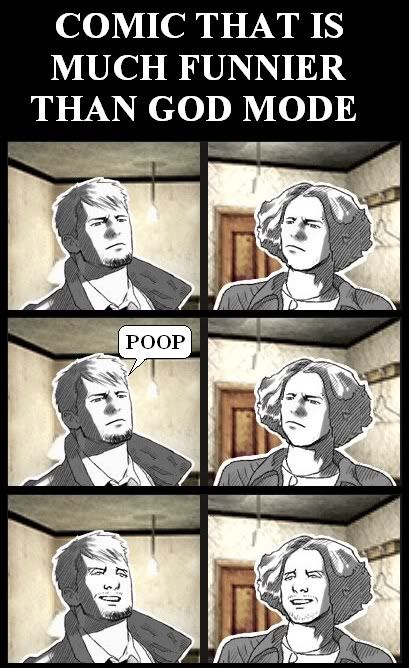
, and I had a friend who stabbed me in the back, I'd chase him to the ends of the earth too. I'd chase him to find answers. On a completely unrelated note, here's a funny comic I found.
You know... that detective lady.
Gender: Female
Location: Chillin' at the precinct
Rank: Medium-in-training
Joined: Wed Feb 28, 2007 1:41 am
Posts: 421
... ...Ahaha, don't mind me, really. *sweatdrop* See that's why I don't usually do that. -_-;;
D.A's Fan Art Thread Updated 06/02
"People should live freely without constraints. That's how life should be!" ~ Richard Wellington
;-;
Gender: Male
Location: In Yur Sink
Rank: Medium-in-training
Joined: Tue Feb 27, 2007 3:58 am
Posts: 372
... ...Ahaha, don't mind me, really. *sweatdrop* See that's why I don't usually do that. -_-;;
De nada.

Anyhow, has anyone made any sprite rips for the game yet? I wouldn't mind making a few comics of my own.
ZOOOOOOOM! BOING!
Gender: Male
Rank: Medium-in-training
Joined: Tue Feb 27, 2007 11:14 pm
Posts: 415

and cool spritecomic
Thanks Sabreae

nuuuuu, stoooooop
Gender: Female
Location: America
Rank: Admin
Joined: Fri Feb 23, 2007 5:16 am
Posts: 5255
That's awesome!

The only "sprite rips" I know of are the ones on the Japanese main page, which I extracted (with Wooster's help) and put on WHAT A!?


;-;
Gender: Male
Location: In Yur Sink
Rank: Medium-in-training
Joined: Tue Feb 27, 2007 3:58 am
Posts: 372
That I knew. Althou if I try using them anywhere... (this is hosted on my photobucket acct, so don't sweat it)

Take on me...
TAKE ON ME
Take me onnn...
TAKE ON ME
I'll be gone...
In a day or TWOOOOOOOOOOOOOOO

The hope that shines through despair.
Gender: Male
Location: Here
Rank: Prosecutor
Joined: Tue Feb 27, 2007 11:04 pm
Posts: 736
;-;
Gender: Male
Location: In Yur Sink
Rank: Medium-in-training
Joined: Tue Feb 27, 2007 3:58 am
Posts: 372

some sort of diabolical mastermind
Gender: Male
Location: Frontier Alpha Centauri
Rank: Medium-in-training
Joined: Tue Feb 27, 2007 8:16 am
Posts: 578
Got proof?


Take me back to Room 215!
Gender: None specified
Location: Ohio!
Rank: Desk Jockey
Joined: Sat Mar 31, 2007 10:41 pm
Posts: 81
Gotten into Room 214.
Had an event in the boiler room.
I've been to 214. Don't remember why, but I can get there now...
Deputy of Self-Esteem
Gender: Male
Location: Connecticut
Rank: Admin
Joined: Thu Feb 22, 2007 8:36 pm
Posts: 3449
Bump - bump - bump - bump - bump - bump - bump
I do declaim that you, sir, are a cad!
Gender: None specified
Location: The Green and Pleasant Land
Rank: Suspect
Joined: Wed Feb 28, 2007 3:07 am
Posts: 12
The hope that shines through despair.
Gender: Male
Location: Here
Rank: Prosecutor
Joined: Tue Feb 27, 2007 11:04 pm
Posts: 736

太多時間
Gender: Male
Location: UK
Rank: Ace Attorney
Joined: Thu Mar 01, 2007 3:39 pm
Posts: 1192



NaruMitsu Fangirl
Gender: None specified
Location: Zanarkand
Rank: Desk Jockey
Joined: Tue Feb 27, 2007 5:20 am
Posts: 53
Got a link?


some sort of diabolical mastermind
Gender: Male
Location: Frontier Alpha Centauri
Rank: Medium-in-training
Joined: Tue Feb 27, 2007 8:16 am
Posts: 578
Got a link?
Here.
OBJECTION!er
Gender: None specified
Rank: Desk Jockey
Joined: Thu Apr 05, 2007 11:26 pm
Posts: 102
>>
*the ground crumbles and shakes before splitting open and this thread rises from the debris, alive again*
even though it has only been two days since the last post, it still feels like i necro-fied it. o.o;
I revive this topic to say i got this game two days ago, and i've just passed chapter one. my only thoughts so far were I LOVE THIS GAME and ATTEMPT TO RIP SPRITES MAYBE. but the second didn't get very far. <<;
I'm trying not to spoil myself, though. but, i need to know one thing... When am i supposed to get change, because i've found four stickers already and i don't want to miss my chance. o.o


Yeah, I'm totally watching you.
Gender: Male
Rank: Donor
Joined: Fri Feb 23, 2007 3:44 am
Posts: 383

some sort of diabolical mastermind
Gender: Male
Location: Frontier Alpha Centauri
Rank: Medium-in-training
Joined: Tue Feb 27, 2007 8:16 am
Posts: 578
And only four quarters, so if you miss your chance or spend them all on NougaChew, only to be eaten by Rosa and Summer, that's it, end of story.
But what do you get for the prize?
Hmm... Your stupidity amuses me so....
Gender: None specified
Location: Northern VA
Rank: Decisive Witness
Joined: Wed Feb 28, 2007 11:28 pm
Posts: 159

The foxy ladies can't resist my sandwich
Gender: Male
Location: The land of Leprechauns and alcoholism.
Rank: Ace Attorney
Joined: Sun Mar 18, 2007 5:15 pm
Posts: 4848

.......
Gender: None specified
Rank: Decisive Witness
Joined: Tue Feb 27, 2007 5:43 am
Posts: 150
Timid Defendant
Gender: Male
Location: Scotland ^^
Rank: Desk Jockey
Joined: Wed Mar 07, 2007 2:27 pm
Posts: 78
picks up the phone) He says "What the hell!?":3
(age 17) Hey Grossberg, I bet you couldn't stuff 11 lemons up your nose! (age 19) You're on!
And that's why :D

"Too Awesome to Die"
Gender: Male
Location: New Arcadia
Rank: Prosecutor
Joined: Tue Feb 27, 2007 3:01 pm
Posts: 712
picks up the phone) He says "What the hell!?":3
Actually, the trailer to Hotel Dusk has him saying "What A...!?" It's even funnier because the trailer's emphasis at that scene is on the words "What the...!?" but they were mistranslated to , "What a...!?"


Gender: Male
Location: Denver, CO
Rank: Decisive Witness
Joined: Tue Feb 27, 2007 4:06 am
Posts: 271

Timid Defendant
Gender: Male
Location: Scotland ^^
Rank: Desk Jockey
Joined: Wed Mar 07, 2007 2:27 pm
Posts: 78
picks up the phone) He says "What the hell!?":3
Actually, the trailer to Hotel Dusk has him saying "What A...!?" It's even funnier because the trailer's emphasis at that scene is on the words "What the...!?" but they were mistranslated to , "What a...!?"
Thanks for the explanation Elias ^_^
(age 17) Hey Grossberg, I bet you couldn't stuff 11 lemons up your nose! (age 19) You're on!And that's why :D
Who is online
You cannot reply to topics in this forum
You cannot edit your posts in this forum
You cannot delete your posts in this forum
You cannot post attachments in this forum
 News
News